September 20, 2026 · 20 min read
RAG, Agentic RAG, and Multi-Agent RAG—Explained Like a Human
A grounded, human guide to three ways AI systems find, reason over, and act on knowledge—from one careful search to a coordinated team of specialists.
RAG · Agentic AI · Multi-Agent Systems · AWS Strands · AI Architecture
Imagine asking three people the same difficult question.
The first person walks to a filing cabinet, finds the most relevant pages, reads them, and answers you. The second person pauses to decide what your question really requires, searches several places, notices a gap, searches again, checks the result, and only then answers. The third person leads a small team: one colleague researches policy, another analyzes numbers, a third looks for risks, and the lead combines their work into one response.
That is the practical difference between RAG, agentic RAG, and multi-agent RAG.
They are often drawn as boxes connected by arrows, which can make them look like three versions of the same plumbing. They are not. Each one gives the model a different amount of responsibility:
- RAG asks, “What evidence should I place in front of the model?”
- Agentic RAG asks, “How should the system look for enough evidence?”
- Multi-agent RAG asks, “Which specialist should investigate each part, and how should their findings be reconciled?”
The progression is not from bad to good. It is from simple to more capable—and from predictable to more expensive, slower, and harder to govern. The best architecture is the least complicated one that can reliably do the job.
First, what problem is RAG trying to solve?
A language model is like a well-read colleague with an unusual memory. It learned patterns from enormous amounts of material, but it does not carry a neat, current copy of your employee handbook, yesterday’s support tickets, this morning’s inventory, or the exact clause in a customer’s contract. Facts inside its trained parameters are difficult to update, difficult to inspect, and not naturally tied to a source.
In 2020, the researchers who named retrieval-augmented generation described a model that combined parametric memory—knowledge compressed into model weights—with non-parametric memory—documents fetched from an external collection. In ordinary language: let the model retain its broad education, but let it open the right book before answering. That is still the heart of RAG.
RAG: an open-book answer
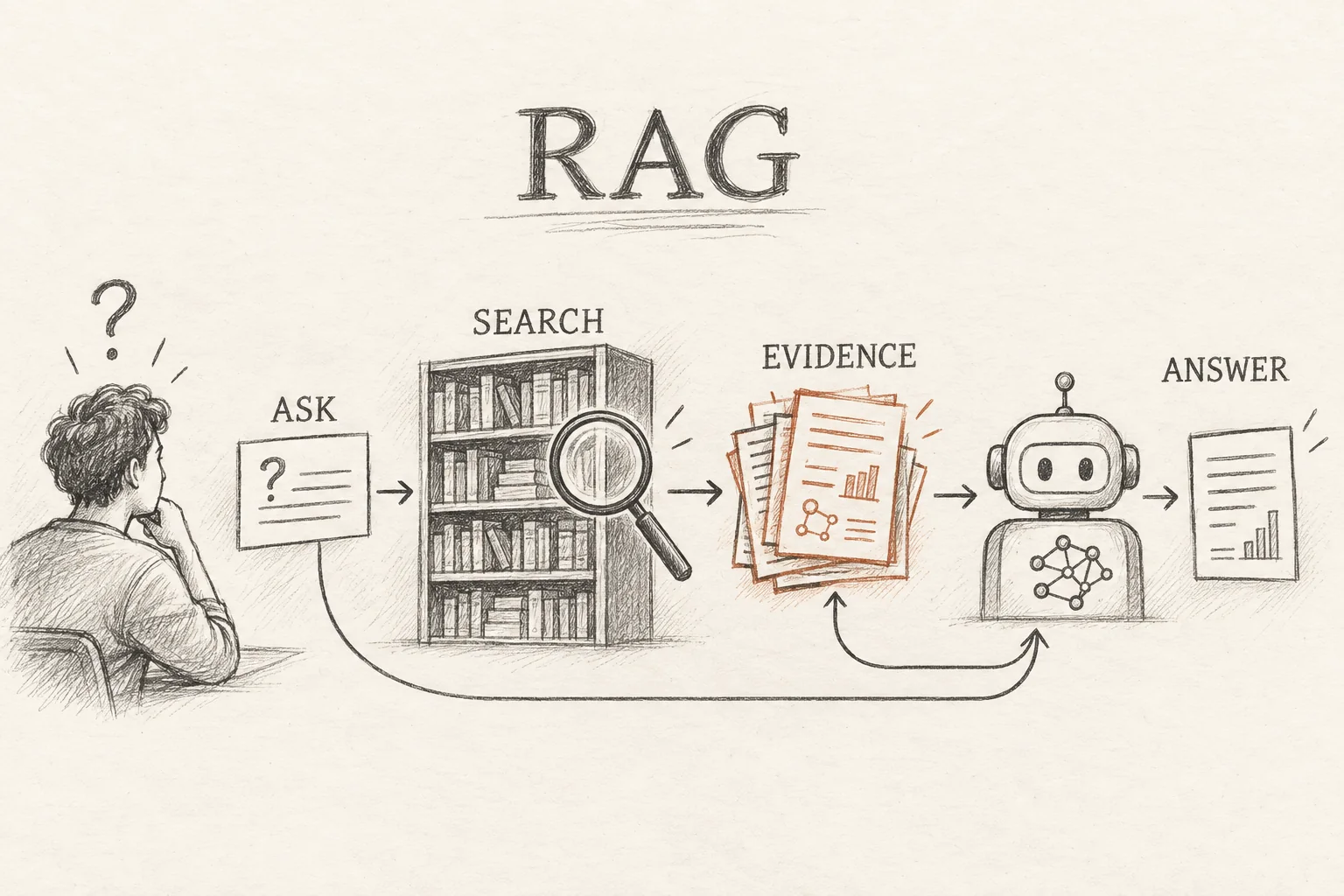
RAG retrieves evidence first and asks the language model to answer from that evidence.
Suppose an employee asks, “Can I carry five vacation days into next year?” A plain language model may answer from a generic understanding of leave policies. A RAG system searches the company’s current handbook, retrieves the paragraph for that employee’s country and employment type, and gives both the question and the paragraph to the model. The model’s job is no longer to remember the policy. Its job is to explain the policy it has just been shown.
That small change has a large purpose: ground the answer in information the organization controls.
What happens behind the answer
There are really two RAG pipelines, although diagrams often show only one.
The first runs before anyone asks a question. Documents are collected, cleaned, divided into useful passages, enriched with metadata, and indexed. Many systems convert each passage into an embedding—a numerical representation of meaning—and store it in a vector index. But vector search is not a requirement. Keyword search, database filters, a knowledge graph, or a hybrid of these can all retrieve evidence. In practice, hybrid search plus reranking is often stronger than treating embeddings as magic.
The second pipeline runs when the question arrives:
- The system interprets or rewrites the question into a search query.
- It retrieves candidate passages.
- It filters or reranks them for relevance and permissions.
- It places the best evidence, the user’s question, and answer instructions into the model’s context.
- The model writes an answer, ideally with citations back to the retrieved sources.
A vector database therefore is not RAG, and a large context window is not RAG. The database is one possible shelf. The context window is the desk on which selected pages are placed. RAG is the whole act of finding the right pages and using them to produce the answer.
Where ordinary RAG earns its keep
RAG is excellent when the user’s question can normally be answered with one retrieval pass over a known body of material:
- An employee assistant explains benefits from approved HR documents.
- A support copilot finds product instructions and drafts a cited reply.
- A lawyer searches a controlled matter repository for relevant clauses.
- A maintenance technician asks for the procedure for a particular machine and serial range.
- An e-commerce assistant answers questions from a live product catalog.
- A developer searches internal documentation, runbooks, and architectural decisions.
It is attractive because the path is short. Short paths are faster, cheaper, easier to test, and easier to audit.
Where ordinary RAG starts to strain
Now ask: “Compare our parental-leave policy in the United States, Canada, and Germany, account for changes made this year, and explain where a transferring employee may lose a benefit.”
One search query may retrieve three plausible passages while missing the amendment, the country exception, or the definition that changes the meaning of “transfer.” The model can only reason over what retrieval supplies. If the crucial page never reaches the desk, fluent generation cannot repair the omission.
Common failure modes include bad document parsing, chunks that separate a rule from its exception, stale indexes, ambiguous terminology, missing access-control filters, weak ranking, and “lost in the middle” context. A citation proves that text came from somewhere; it does not prove that the source was authoritative, current, or interpreted correctly.
Frameworks and platforms for RAG
The framework should match the shape of the work, not the popularity of its logo.
| Framework or platform | Best fit | Typical use case |
|---|---|---|
| LangChain | A broad integration layer with many loaders, retrievers, models, and vector stores | A team that needs to assemble a RAG application across several vendors quickly |
| LlamaIndex | Data ingestion, indexing, retrieval, and document-centric query engines | A knowledge assistant over large, heterogeneous document collections |
| Haystack | Explicit, modular pipelines with strong control over retrieval and ranking | A production search or question-answering service whose stages must be inspectable |
| Amazon Bedrock Knowledge Bases | Managed ingestion and retrieval inside an AWS architecture | An AWS team that wants managed RAG over S3 and enterprise data sources without owning every indexing component |
| Azure AI Search / Foundry IQ | Hybrid and semantic retrieval with managed, permission-aware knowledge sources | A Microsoft estate that needs enterprise search and grounding for copilots or agents |
These choices overlap. LangChain, LlamaIndex, and Haystack can all build more than classic RAG; managed cloud services can sit behind any agent framework. The useful question is not “Which framework wins?” but “Which layer do I want to own?”
Agentic RAG: give the researcher a goal, not just a query
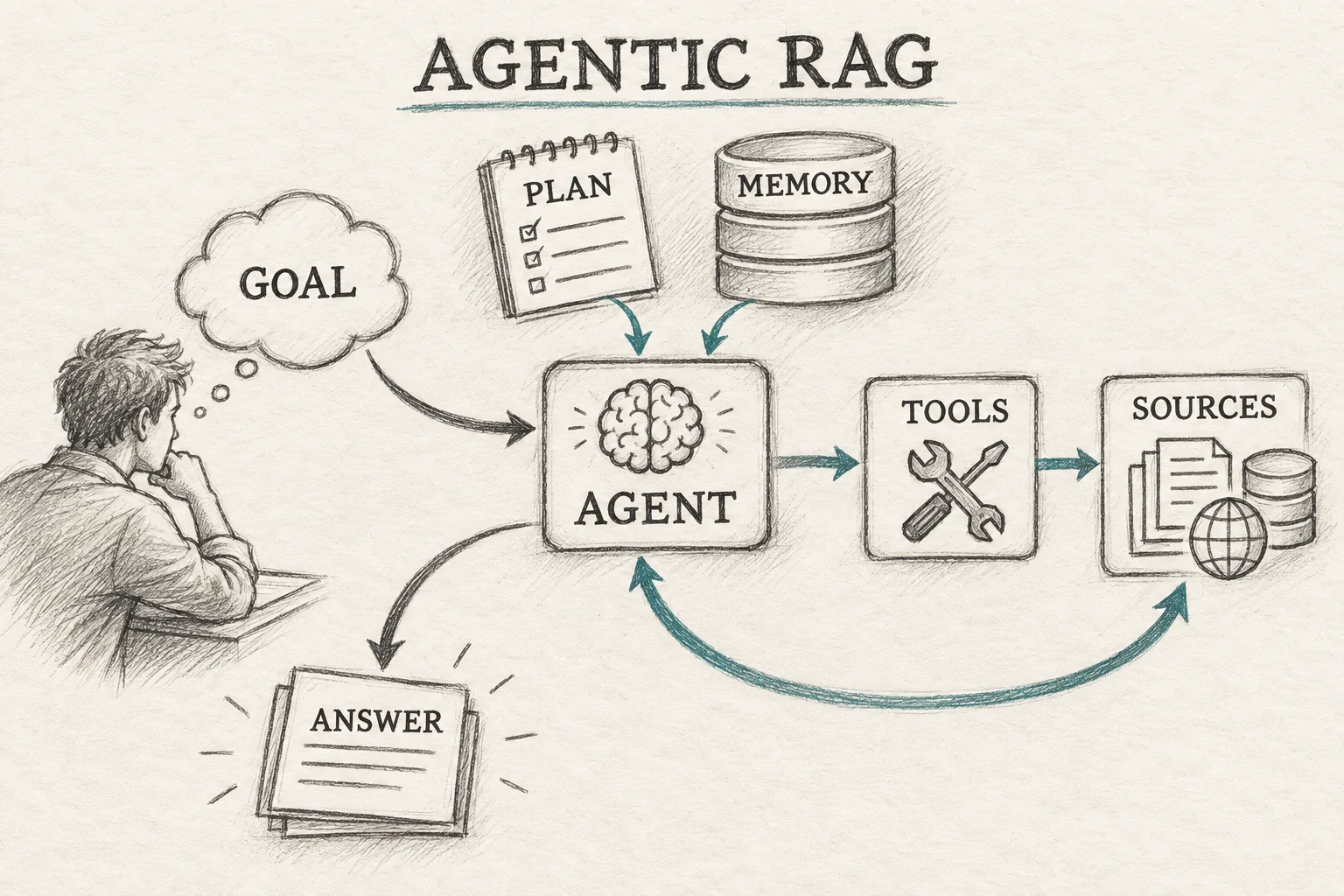
Agentic RAG can plan, use tools, inspect what came back, and retrieve again.
Return to the employee transferring from the United States to Germany. A capable researcher would not type the entire request into one search box and trust the first five results. They would split it into questions: What is the U.S. entitlement? What is the German entitlement? Which policy version applies on the transfer date? Are statutory benefits different from company benefits? They might search the handbook, query the HR system for employment status, calculate dates, and ask a follow-up question if the destination entity is unclear.
Agentic RAG gives the system permission to behave more like that researcher.
An agent receives a goal, not merely a search string. It chooses a next step, calls a search or business tool, observes the result, updates its working state, and decides whether the evidence is sufficient. The loop ends when the agent can answer, reaches a budget or step limit, needs human clarification, or fails safely.
The “agentic” part is the decision loop. Retrieval remains important, but it becomes one tool among several. An agent may search a vector index, run SQL, call a pricing API, open a web page, execute code, or ask another system for permission-aware data.
A concrete example: investigating a late shipment
A customer asks, “Why is order 4817 late, and what can you do about it?”
Ordinary RAG may find the shipping policy and explain standard delivery windows. An agentic system can do more:
- Retrieve the policy and the order’s promised delivery terms.
- Call the order API to inspect status and timestamps.
- Query the carrier using the tracking number.
- Notice that the parcel has not moved in 72 hours.
- Check whether the order qualifies for replacement or refund.
- Draft the explanation and proposed remedy.
- Ask a human to approve the refund if the amount exceeds the agent’s authority.
This is useful because the answer depends on discovery and action, not merely on finding a paragraph.
When agentic RAG is the right tool
Use it when the route to the answer is not known in advance, but can be bounded:
- Deep research that must reformulate questions and follow evidence.
- Root-cause analysis across logs, tickets, runbooks, and live telemetry.
- Procurement research that compares requirements, vendors, prices, and policy.
- Compliance review that must locate rules, test a case, and identify missing evidence.
- Customer service that combines knowledge retrieval with account-specific actions.
- Data analysis in which the system must decide which tables, queries, or calculations it needs.
Do not add an agent merely because the word sounds modern. If the steps are stable—retrieve a document, extract fields, validate them, write a record—a deterministic workflow will usually be safer. Let code decide what code can decide; reserve model judgment for the genuinely ambiguous parts.
Frameworks for agentic RAG
| Framework | Architectural character | Strong use case |
|---|---|---|
| AWS Strands Agents | Lightweight and model-driven: a model, a system prompt, and tools form the core loop | AWS-centered assistants that need Bedrock, MCP tools, memory, observability, and a clean path to AgentCore |
| LangGraph | Stateful graph orchestration with explicit nodes, transitions, persistence, and human interrupts | Long-running agents where the team wants tight control over state and recovery |
| OpenAI Agents SDK | A small set of primitives around agents, tools, handoffs, guardrails, sessions, and tracing | Tool-using or voice agents built primarily on OpenAI’s platform |
| Google Agent Development Kit (ADK) | Code-first agent construction with Gemini and Vertex AI integration plus A2A support | Gemini-based research, customer-service, or enterprise agents on Google Cloud |
| Microsoft Agent Framework | Python, .NET, and Go agents plus durable, graph-based workflows and Foundry integration | Enterprise agents in Microsoft environments, especially where .NET and Azure matter |
LlamaIndex and Haystack also support agentic patterns, and LangChain now positions its higher-level agents on top of LangGraph. The boundaries are moving because “RAG framework” and “agent framework” are becoming less useful labels than the capabilities beneath them: retrieval, state, tools, orchestration, evaluation, and deployment.
Multi-agent RAG: a team, not a larger brain
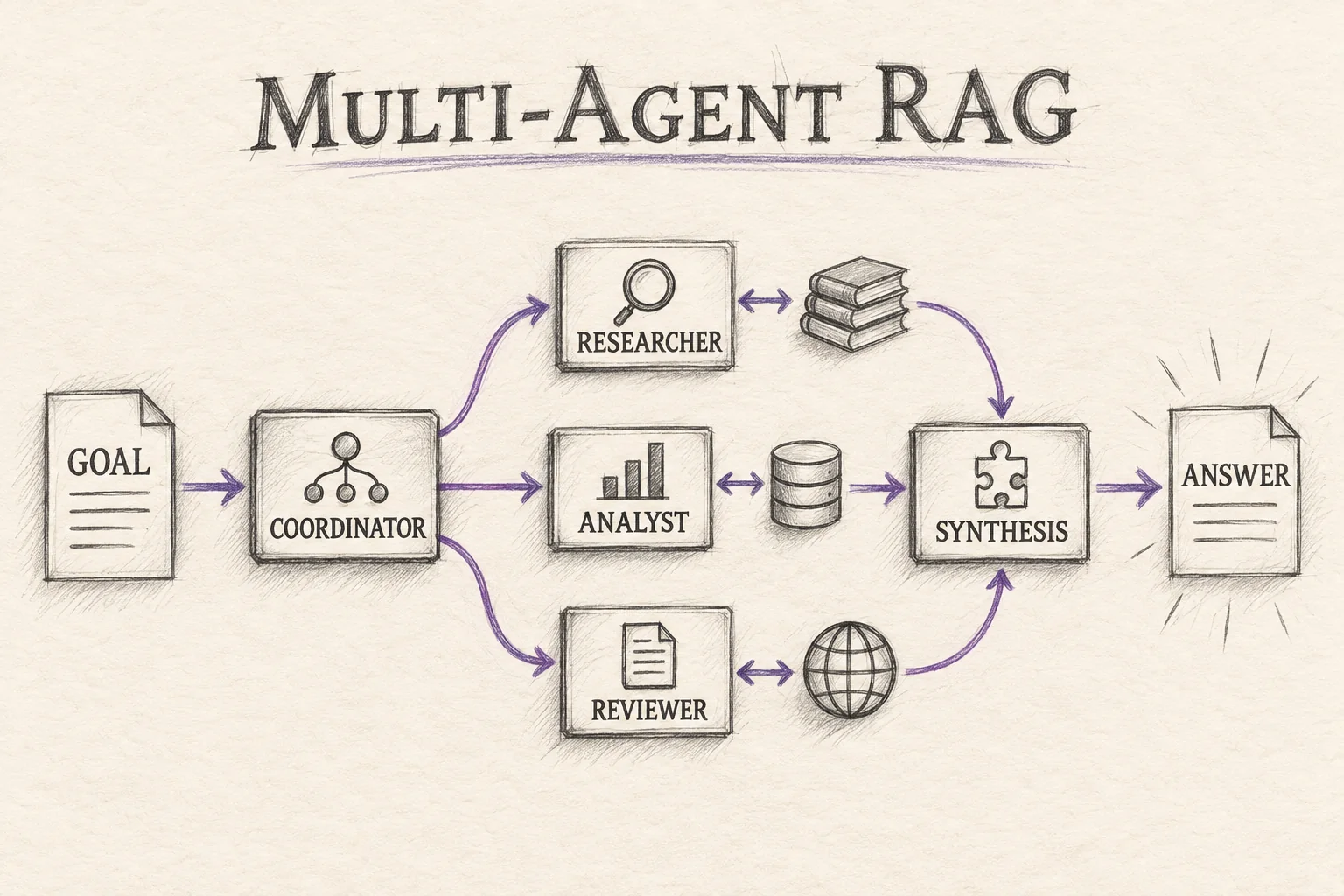
Multi-agent RAG divides a problem among specialists, then brings their evidence and conclusions back together.
Imagine a company considering the acquisition of a smaller competitor. The question “Should we buy this business?” hides several different jobs. Someone must inspect the financials. Someone must compare products and customers. Someone must review contracts and regulatory exposure. Someone should challenge rosy assumptions. The people may use different data, tools, permissions, and standards of proof.
One giant prompt can assign all those roles to one model, but it does not create true separation of context or responsibility. A multi-agent system creates several bounded workers—often backed by the same underlying model—with different instructions, tools, memories, and data access. A coordinator delegates work and synthesizes the result.
The intelligence is not created by drawing more boxes. It comes from decomposition, specialization, parallel work, and independent checking.
Four useful collaboration patterns
Agents as tools is the cleanest starting point. A coordinator invokes a tax specialist or research agent the way it invokes any other tool. Context stays bounded, and responsibility is clear.
A graph makes the routes explicit. Research must finish before analysis; legal and finance can run in parallel; review happens only after both are complete. This is a good fit when governance matters more than conversational freedom.
A handoff or swarm lets one agent transfer control to another based on the situation. This can work well for triage, open-ended exploration, and brainstorming, but emergent routing is harder to predict and test.
A debate or evaluator pattern asks several agents to propose or critique answers and uses another component to select or synthesize. It can improve difficult reasoning, but agreement among similar models is not the same thing as truth.
Where a multi-agent system is justified
Multi-agent RAG becomes reasonable when at least one of these is true:
- The task has genuinely independent specialties or data domains.
- Work can run in parallel and latency matters.
- Context is too large or noisy for one agent to manage well.
- Different agents need different credentials or least-privilege boundaries.
- An independent reviewer or adversarial check adds measurable value.
- Separate teams or vendors already own agents that must collaborate.
Examples include due diligence, clinical-trial operations, complex incident response, supply-chain planning, scientific literature review, and enterprise requests that cross HR, finance, legal, and IT.
It is a poor fit when the agents merely pass prose around, repeat the same search, or exist only to imitate a corporate org chart. Every additional agent creates more tokens, more latency, more failure paths, more permissions, and another trace a human may need to understand.
Frameworks for multi-agent RAG
| Framework | Multi-agent strength | Strong use case |
|---|---|---|
| AWS Strands Agents | Agents-as-tools, graphs, workflows, swarms, and protocol-based collaboration | A research-and-review team on AWS, from a controlled graph to exploratory peer handoffs |
| CrewAI | Role-oriented “crews” and task processes are central concepts | Business automation where roles such as researcher, writer, and reviewer map naturally to the work |
| LangGraph | Explicit shared state, supervisors, subgraphs, checkpoints, and interrupts | Auditable teams of agents whose routes and recovery behavior must be engineered |
| Microsoft Agent Framework | Sequential, concurrent, group-chat, handoff, and graph workflows | Multi-agent applications spanning .NET/Python services and Microsoft Foundry |
| Google ADK + A2A | Local teams plus open agent-to-agent discovery and delegation | Collaboration between agents built by different teams or running on different platforms |
| OpenAI Agents SDK | Handoffs and agents-as-tools with built-in tracing and guardrails | Focused specialist routing without introducing a large orchestration abstraction |
Microsoft’s AutoGen remains widely recognized and heavily starred, but teams beginning a new Microsoft-centered system should evaluate Microsoft Agent Framework, which consolidates the direction of AutoGen and Semantic Kernel. Existing AutoGen deployments do not become wrong overnight; migration value depends on the production features they need.
Why AWS Strands is my favorite
Strands fits the way I prefer to build: start with a small amount of code, give the model a carefully bounded toolbelt, observe what it does, and add explicit structure only when the problem proves it needs structure.
Its basic model-driven idea is easy to hold in one’s head: model + instructions + tools. That is enough for a single agentic RAG loop. When the job grows, the same ecosystem supports agents-as-tools, graphs, workflows, or swarms rather than forcing every prototype to begin as a distributed society of agents.
It is also AWS-native without being model-locked. Bedrock is the natural default; AgentCore provides managed runtime capabilities; Lambda, Fargate, and EC2 remain deployment choices; OpenTelemetry supports observability; and MCP or A2A can connect tools and peer agents across platform boundaries. AWS reports that Strands passed 14 million downloads after its May 2025 open-source release and is used inside services such as Amazon Q, AWS Glue, and VPC Reachability Analyzer. That is meaningful traction for a younger framework, though downloads are not the same as active production installations.
Three places I would reach for it are:
- A production support investigator: one agent searches runbooks and tickets, queries CloudWatch, checks service health, and prepares a diagnosis for approval.
- A controlled research team: a coordinator calls separate evidence-gathering, analysis, and review agents, with every path traced.
- An AWS operations assistant: narrowly scoped tools inspect infrastructure, draft a change, and require a human before any consequential action.
The attraction is not “maximum autonomy.” It is the ability to add judgment without giving up the engineering disciplines around it.
So which one should you choose?
Here is the simplest decision rule I know:
| If the real need is… | Start with… | Why |
|---|---|---|
| Answer from a known body of knowledge | RAG | One retrieval path is cheaper, faster, and easier to evaluate |
| Investigate, choose tools, or retrieve repeatedly | Agentic RAG | The system needs a bounded decision loop |
| Divide work among real specialties or trust boundaries | Multi-agent RAG | Separation and coordination add value that one context cannot |
Then ask four uncomfortable questions before moving to the next level:
- Did retrieval quality—not model intelligence—cause the failure?
- Could query decomposition and reranking solve it without an open-ended agent?
- Can a deterministic workflow encode most of the path?
- Does another agent add a distinct capability, data boundary, or independent check?
If the answer to the last question is no, the extra agent is probably theater.
A note on “market share”
There is no audited, apples-to-apples market-share dataset for AI agent frameworks. Most are open source, many applications combine several, managed-cloud use is private, download counters include CI and mirrors, and GitHub stars measure attention rather than production adoption.
The most honest public snapshot is therefore ecosystem footprint, not market share. As of September 20, 2026, major repositories show approximately:
| Project | Public GitHub interest | What the number does—and does not—suggest |
|---|---|---|
| LangChain | 146.7k stars | The broadest visible developer mindshare in this sample; also the oldest and broadest scope |
| Microsoft AutoGen | 61.1k stars | Large historical multi-agent community; new Microsoft work is shifting toward Agent Framework |
| CrewAI | 58.8k stars | Strong interest in role-based multi-agent orchestration |
| LlamaIndex | 52.2k stars | A major document and retrieval ecosystem |
| LangGraph | 42.0k stars | Strong traction for stateful, controllable agent orchestration |
| OpenAI Agents SDK | 29.6k stars | Rapid adoption around a focused, vendor-backed agent SDK |
| Haystack | 26.6k stars | Durable production-oriented retrieval and orchestration community |
| AWS Strands Agents | 7.4k stars in its main harness repository; 14M+ downloads reported by AWS | Younger ecosystem with strong AWS distribution; stars and downloads are different measures |
Use these numbers to understand awareness and community gravity, not to select an architecture. A smaller framework that aligns with your cloud, language, governance model, and operations team can be the better commercial decision.
Where the industry is going from here
The future is not simply “more agents.” Several more useful shifts are happening at once.
Retrieval is becoming a real knowledge layer
Early RAG often meant splitting PDFs every 500 tokens and placing embeddings in a vector database. The modern stack is moving toward hybrid retrieval, semantic reranking, query decomposition, structured filters, knowledge graphs, multimodal sources, freshness guarantees, and document-level access control. Microsoft’s current agentic retrieval, for example, decomposes complex questions into focused subqueries, runs them in parallel, reranks them, and returns merged grounding data plus references and an activity log.
The important product is no longer “a vector store.” It is a permission-aware, observable knowledge service that both humans and agents can trust.
Protocols are replacing one-off connectors
MCP standardizes how an AI application discovers and uses tools and context. A2A standardizes how one agent discovers, delegates to, and exchanges work with another. A useful shorthand is: MCP connects an agent to capabilities; A2A connects an agent to peers.
That distinction matters. The industry is moving from frameworks that try to own every integration toward systems that can cross vendor and organizational boundaries. MCP’s donation to the Linux Foundation’s Agentic AI Foundation and the growth of A2A reflect that push toward shared infrastructure.
Agents will receive identities, budgets, and smaller keys
An agent that can retrieve a handbook is a search feature. An agent that can issue a refund, modify infrastructure, or send private data is a security principal. It needs its own identity, narrowly scoped authorization, short-lived credentials, spending and step limits, human approval for consequential actions, and a durable audit trail.
This is not hypothetical housekeeping. NIST’s 2026 work on agent security reports broad agreement that agents create distinct threats when model outputs are connected to real software capabilities. Prompt injection can arrive inside a retrieved document or tool result and attempt to redirect the agent. More tools and agents expand the attack surface.
Evaluation will move from the final sentence to the whole journey
Traditional language-model evaluation asks whether the answer looks correct. Agent evaluation must also ask whether the right source was retrieved, the right tool was chosen, arguments were valid, permissions were respected, loops terminated, citations supported the claims, and the cost and latency stayed within budget.
Tracing, replayable runs, retrieval test sets, adversarial documents, tool simulations, and outcome-based evaluations will become ordinary engineering work. The winning production system may not be the one that answers a benchmark question most elegantly. It may be the one that fails visibly, cheaply, and safely.
The likely production shape is hybrid
Most serious systems will combine deterministic workflows with bounded agentic decisions. Code will enforce policy, permissions, schemas, budgets, and transaction boundaries. Models will interpret messy requests, choose among approved tools, synthesize evidence, and explain outcomes. Humans will remain at the boundaries where authority, money, safety, or irreversible change is involved.
That future is less cinematic than a swarm of autonomous digital employees. It is also more useful.
The enduring lesson
RAG gives a model an open book. Agentic RAG gives it a research process. Multi-agent RAG gives it a team.
Each step can solve a harder class of problem, but each step also creates more ways to be slow, expensive, confusing, or unsafe. Begin with trustworthy knowledge. Improve retrieval before adding autonomy. Add a decision loop only when the path cannot be fixed in advance. Add another agent only when specialization, parallelism, or a trust boundary makes the whole system measurably better.
The real craft is not making the diagram larger. It is deciding how much judgment the machine needs—and where human judgment must remain.
Sources and further reading
- Patrick Lewis et al., “Retrieval-Augmented Generation for Knowledge-Intensive NLP Tasks” (2020).
- Microsoft, “Agentic retrieval in Azure AI Search”.
- AWS, “Introducing Strands Agents, an Open Source AI Agents SDK”.
- AWS, “Multi-Agent collaboration patterns with Strands Agents and Amazon Nova”.
- AWS, “Introducing Strands Labs”, including the reported 14M+ Strands downloads.
- OpenAI, “New tools for building agents”.
- Anthropic, “Donating the Model Context Protocol and establishing the Agentic AI Foundation”.
- Google, “Announcing the Agent2Agent Protocol”.
- NIST, “Summary Analysis of Responses Regarding Security Considerations for AI Agent Systems”.