October 16, 2025 · 4 min read
The Genius of Cheat Sheets: Understanding LoRA Fine-Tuning
How do you teach a giant AI new tricks without spending a fortune? Let's debug the magic of Low-Rank Adaptation (LoRA) using the power of 'cheat sheets'.
GenAI · Machine Learning · MLOps · Fine-Tuning
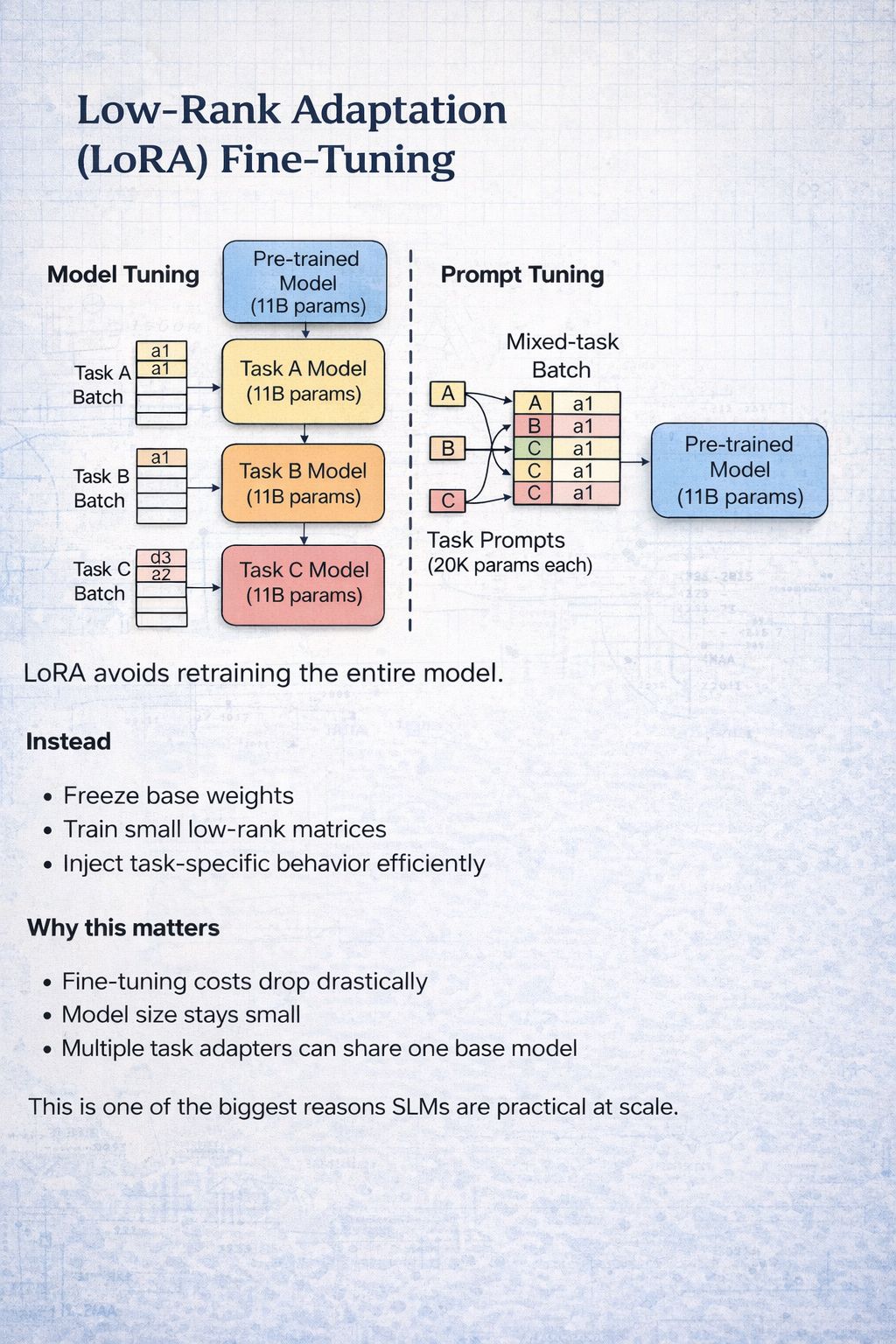
Imagine you have hired the smartest person in the world. This person has read the entire internet, speaks every language, and can code in their sleep. In the AI world, we call this a “Pre-trained Model.” If you look at the top of our diagram, this is the big blue box labeled “Pre-trained Model (11B params).” That “11B” means it has 11 billion bits of knowledge. It is a brilliant generalist, but it doesn’t yet know the “secret sauce” of your specific business.
The Old, Expensive Way: Rebuilding the University
In the past, if you wanted this genius to become an expert in Task A (like medical diagnosis), you had to send them back to school. You would take that massive 11-billion parameter brain and retrain the whole thing.
As shown on the left side of the image under “Model Tuning,” you end up with a completely separate “Task A Model (11B params).” If you wanted experts for Task B and Task C, you’d end up with three massive models.
The Problem: Storing and running three separate “universities” is incredibly expensive and slow. It’s like building a whole new school every time you want to teach one new class.
Enter LoRA: The Ultimate AI Cheat Sheet
AI researchers found a better way called LoRA (Low-Rank Adaptation). Instead of retraining the whole brain, LoRA asks: “What if we just give the genius a cheat sheet?”
Here is how LoRA works in plain English:
- Freeze the Brain: We take our 11B parameter model and “freeze” it. We tell it: “Don’t change anything you already know. You’re perfect as a generalist.”
- Create Tiny Adapters: Instead of changing the big brain, we create tiny, specialized “adapters” (the small boxes A, B, and C in the diagram).
- Inject Knowledge Efficiently: These adapters are tiny—only 20K parameters compared to the 11B in the main brain. They are essentially specialized “cheat sheets” that tell the brain how to behave for one specific task.
A Real-World Example: The Specialist Doctor
Imagine one giant AI brain (the 11B model). You need it to handle three different types of patients:
- Task A: Reading Oncology X-rays.
- Task B: Translating medical jargon for children.
- Task C: Summarizing insurance billing codes.
Without LoRA: You would need three separate, massive computers running three separate 11B models. With LoRA: You keep one giant model. When an X-ray comes in, the AI “picks up” the tiny Task A cheat sheet, answers the question, and then puts it back. A second later, when a billing question comes in, it swaps to the Task C cheat sheet.
Why This Changes Everything
The bottom of our image highlights why LoRA is one of the biggest reasons Small Language Models (SLMs) are now practical at scale:
- Costs Drop Drastically: Training a 20K parameter “cheat sheet” is pennies compared to retraining an 11B parameter brain.
- Storage is Easy: You don’t need massive hard drives for every task; you just store the tiny adapters.
- Speed: You can switch between being a “Doctor” and a “Lawyer” instantly just by swapping the adapter.
LoRA allows us to take a “Frozen” giant and make it an expert in anything—affordably, quickly, and at scale.