October 18, 2025 · 8 min read
Small Language Models (SLMs): Why Smaller is Often Smarter
In the AI world, we’ve been told that bigger is always better. But for most businesses, a massive model is overkill. Here is why Small Language Models (SLMs) are becoming the secret weapon for real-world applications.
AI · Machine Learning · SLM · LLM · Optimization
Moving Past the “Bigger is Better” Mindset
For a long time, the trend in Artificial Intelligence was simple: add more data, add more “parameters” (essentially the model’s brain cells), and it gets smarter. That gave us the massive Large Language Models (LLMs) we use today. They are great at knowing a little bit about everything.
But lately, the conversation has changed. We’re realizing that for many specific jobs, you don’t need a giant brain that knows how to write poetry and code at the same time. You need a specialist. That is where Small Language Models (SLMs) come in.
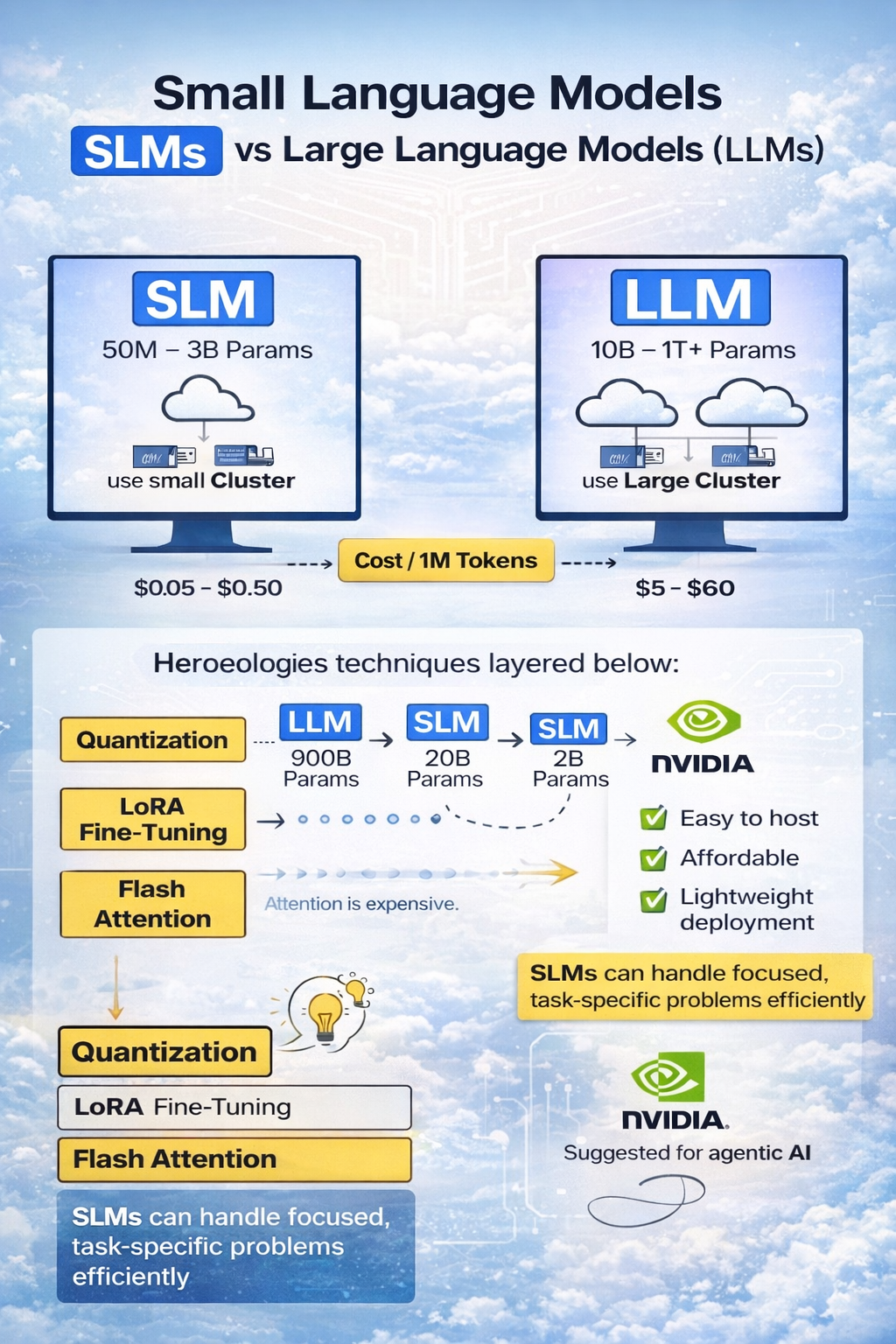
What exactly is an SLM?
Think of an LLM as a massive, multi-floor city library. It’s got everything, but it takes a lot of energy to keep the lights on and a long time to find one specific book.
An SLM is like a specialized handbook. It’s built with fewer “parameters” (usually under 10 billion), making it lean, fast, and very good at one specific subject.
While an LLM might have a trillion parameters, an SLM usually lives in the 50 million to 3 billion range. It’s much lighter on its feet.
The Efficiency Secret: Doing More with Less
It turns out that if you give a “small” 2-billion parameter model a very specific task—like answering customer support tickets or organizing data—it can perform just as well as the giants.
Why Specialists Win
Because SLMs are built for focus, they tend to beat the bigger models in areas where you need precision rather than general knowledge:
- Logic and Math: Solving specific puzzles without getting confused.
- Customer Support: Knowing your specific company’s products inside and out.
- Coding: Generating clean code for a specific language or framework.
How do we make them so small?
We don’t just “cut” the models in half. We use a few clever tricks to shrink them down without losing the “IQ”:
- Quantization: Think of this like lowering the resolution of a photo so it takes up less space, but still looks clear enough to see the details.
- LoRA Fine-Tuning: Instead of retraining the whole “brain,” we only tweak the specific parts that matter for the job. It’s like changing the tires on a car instead of rebuilding the whole engine.
- Flash Attention: A faster way for the AI to “read” and pay attention to what matters in your prompt, cutting down the wait time.
The Bottom Line: Costs and Speed
For a business, the biggest reason to switch to an SLM is the bank account. Running a giant model is expensive and requires massive server farms.
| Feature | Small Language Model (SLM) | Large Language Model (LLM) |
|---|---|---|
| Hardware | Can run on a single laptop/GPU | Needs a room full of servers |
| Cost per Use | Pennies (very cheap) | Dollars (can get expensive) |
| Speed | Near-instant | Sometimes has a “lag” |
Real-World Practicality
Industry leaders like NVIDIA are leaning into SLMs because they are practical. They are easy to host on your own private servers (which is better for security) and they don’t cost a fortune to keep running every day.
Final Thought
As we move toward a world of “AI Agents” that do tasks for us, we don’t always need a sledgehammer. Most of the time, a scalpel is the better tool. SLMs give us that precision without the massive bill at the end of the month.