January 19, 2026 · 8 min read
Choosing the Right AI System: Simple Models, Reliable Workflows, and Smart Agents
Not all AI works the same way. Some answer once and stop. Some follow strict instructions. Others think, adjust, and try again. This guide explains AI system designs in plain language—so you can choose wisely, not blindly.
AI · LLMs · Agentic AI · System Design · AI Basics
When people talk about AI, most of the time they talk about models. Which model is better, which one is newer, which one sounds smarter. But in real life, the success of an AI system does not depend only on the model. It depends much more on how the system is designed and how it is used.
AI systems are not all the same. Some systems are made to answer a question once and stop. Some systems follow a fixed set of steps, like a process. Some systems are allowed to plan, take actions, see what happens, and then adjust their next step. Each design is made for a different kind of problem, and each one has clear limits.
This article explains three common AI system designs: single LLM features, structured workflows, and autonomous agents. These are not competing ideas. They are different tools, meant for different situations. Using the wrong design for a task usually creates more problems than it solves.
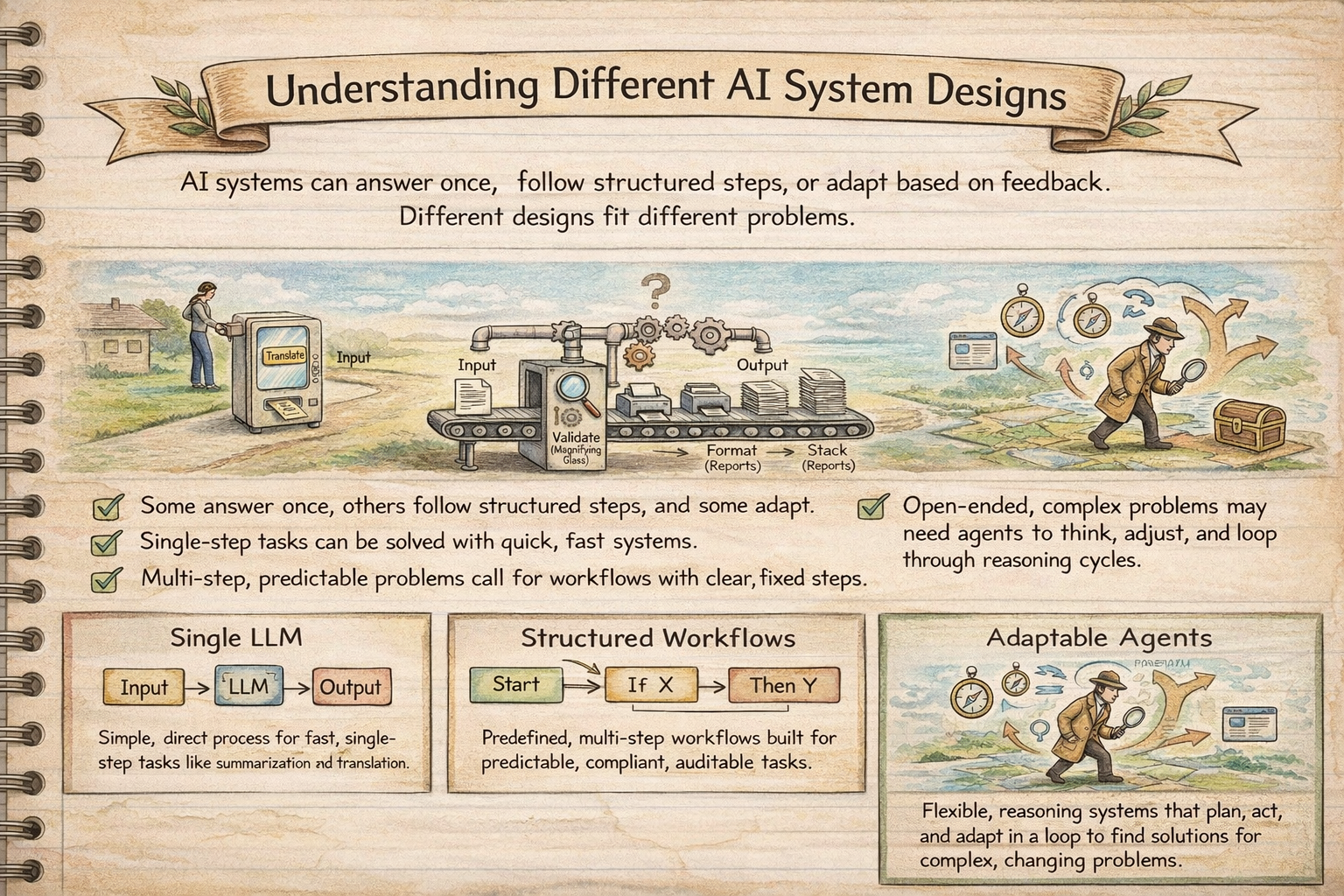
Single LLM features are the simplest type of AI system. In this design, you give an input to the language model and you get an output. The system does not remember anything from before. Every request is handled on its own. This approach works well for simple tasks like summarizing text, translating language, classifying content, or extracting information. It is fast, easy to build, and low cost. But it cannot handle multi-step thinking or adapt to changing situations.
Structured workflows are used when tasks have multiple steps and must be done in a fixed and predictable way. In this design, the steps are defined in advance. The system knows exactly what to do first, what to do next, and when to stop. These workflows are very useful for repetitive tasks and for areas where rules, compliance, and audit are important. Examples include document processing, financial transactions, and healthcare records. Structured workflows are reliable and easy to monitor, but they are not flexible. If the situation changes, the workflow must be updated manually.
Autonomous agents are used for more complex and open-ended tasks. In this design, the system works in a loop. It plans an action, performs it, observes the result, and then decides what to do next. The agent can remember previous steps, choose tools as needed, and adjust its behavior based on feedback. This makes agents suitable for tasks where the path is not clear from the start, such as research, troubleshooting, or adaptive assistance. However, agents are more complex, cost more to run, and need strong monitoring and safeguards.
In real systems, these designs are often combined. Many practical AI solutions use structured workflows for reliability and control, and use agents only where flexibility is truly needed. Standards such as the Model Context Protocol (MCP) and Agent Communication Protocol (ACP) help manage and govern these mixed designs.
Choosing the right AI system design is about matching the system to the task. Simple tasks should use simple designs. Predictable tasks should use structured workflows. Complex and changing problems may require agents. Understanding these differences helps in building AI systems that are useful, reliable, and safe to operate.